Introduction: Moving from Passivity to Action
When will European leaders step up and concretely engage in peace solutions for the conflict between Russia and Ukraine?
Are we truly at a point where only the U.S. President is attempting to mediate between the parties, while European leaders appear totally paralyzed by inaction and lacking the slightest initiative to offer themselves as peace brokers? The question arises whether this is due to a reluctance to engage with the Russian government, or if the absence of a common European vision is hindering action.

We owe the Ukrainian people a greater effort. A pragmatic approach that includes Russia in trade and diplomacy once hostilities have ceased—as the United States is potentially suggesting—is the most viable path to creating a lasting peace and sending a positive signal to the Russian people, the majority of whom wish to be part of the European family.
The Vital and Pragmatic Role of the United States
The U.S. plays a highly significant role in defending Ukraine. Simultaneously, they wish to maintain a good relationship with the Russian people, government, and business community once the fighting is concluded. Washington has adopted a more pragmatic or diplomatic line.
It must be presumed that American services have informed the President that Ukraine must necessarily remain neutral, and that for peace to be achieved, Russia must be granted space on the Crimean Peninsula—a viewpoint the U.S. seems to have held since the beginning of the current administration. This places European leaders in a dilemma. On one side stands the Ukrainian government and people, who will not surrender land for peace. On the other side stand strategic realities.
European nations bordering Russia, as well as strong nations such as Germany, the UK, and France, must, in cooperation with the U.S., formulate a plan that can be presented to Ukraine and Russia, containing enough elements to bring the parties to the negotiating table.
A Holistic Package Solution: The 20 Points of the Peace Plan
The 20-point plan below is a formal draft for a holistic solution that addresses military, humanitarian, geopolitical, and economic issues:
- Ukraine receives additional air defense systems from 30+1 allied states.
- 28 states dispatch international observers to Ukrainian cities within the current year.
- A ceasefire is established.
- Individuals, including prisoners and refugees, located in Russia are returned to Ukraine.
- Ukraine returns Russian prisoners to Russia.
- Over 50 states provide support for the reconstruction and financing of Ukraine.
- Demilitarized zones are established in Eastern Ukraine.
- Russian forces withdraw to the Crimean Peninsula.
- Arrangements for coexistence on the Crimean Peninsula are established, including the possibility of dual citizenship.
- The Donbas region is granted autonomy in trade and cultural matters.
- Russia appoints special advisors for trade and culture to the regions of Donetsk, Luhansk, Zaporizhzhia, and Kherson.
- Frozen Russian assets are released.
- Sanctions against Russian citizens and against Russia are lifted.
- Normal trade and diplomatic relations with Russia are re-established.
- Russia contributes to the financing of the reconstruction of Mariupol.
- Ukraine declares military neutrality.
- The EU resumes energy imports from Russia.
- Russia gains access to the international systems for financial transactions.
- Russian minorities in the Baltic states and in Ukraine are guaranteed the right to practice and preserve their culture.
- An EU–NATO Council is established, focusing on trade, disarmament, geopolitics, and military exercises.
International Observer Mission: From Observer to Peace Controller
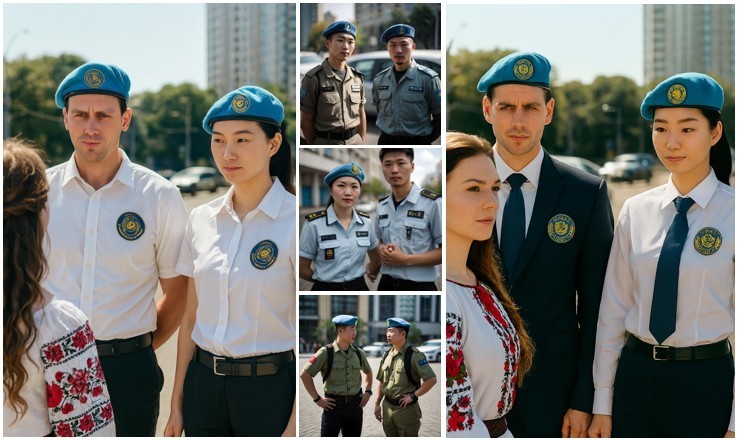
The time has come for the international community to dare to deploy observers to the country. These observers must be stationed in cities to report back to their own governments and to an international body on the daily life of the Ukrainian people.
Should a ceasefire soon be established, these observers would already be in place, and their role could immediately shift from passive observer to active Peace Controller. These controllers should not be armed beyond a standard sidearm (pistol) for self-defense.
The logistical and operational details for this 10,000-strong mission are specified in the following annexes:
Logistical Annexes for the Observer Mission
Composition of the Mission
The mission should be composed of individuals with diverse backgrounds to ensure holistic and credible reporting.
| Category | Share of Mission | Purpose and Expertise |
|---|---|---|
| Experienced Diplomats/Officials | 20% | Leadership, political analysis, and diplomatic communication. |
| Peace Researchers and Analysts | 25% | Data collection on daily life, social dynamics, and early warning. |
| Logistics and Security Specialists | 20% | Security assessments, communication, and armed self-defense (sidearm). |
| Legal Experts and War Crimes Specialists | 15% | Documentation of violations of International Humanitarian Law (IHL). |
| Infrastructure/Reconstruction Specialists | 10% | Assessment of damage to critical infrastructure and reconstruction needs. |
| Medical Personnel and Psychologists | 10% | Emergency support and assessment of mental health status in local communities. |
| Total | 100% |
Distribution of the 10,000 Observers in Ukraine’s Largest Cities
The 10,000 observers are distributed proportionally across the 30 largest cities, operating a 24/7 rotation system (each 5-person team has 5 reliefs, totaling 10 individuals per 24/7 unit).
| No. | City | Assigned Observers | No. | City | Assigned Observers |
|---|---|---|---|---|---|
| 1. | Kyiv (Kiev) | 1,930 | 16. | Chernihiv | 180 |
| 2. | Kharkiv | 930 | 17. | Kherson | 190 |
| 3. | Odesa | 660 | 18. | Poltava | 190 |
| 4. | Dnipro | 640 | 19. | Khmelnytskyi | 180 |
| 5. | Donetsk | 590 | 20. | Cherkasy | 180 |
| 6. | Zaporizhzhia | 470 | 21. | Chernivtsi | 170 |
| 7. | Lviv | 470 | 22. | Zhytomyr | 170 |
| 8. | Kryvyi Rih | 400 | 23. | Sumy | 170 |
| 9. | Mykolaiv | 310 | 24. | Rivne | 160 |
| 10. | Sevastopol | 300 | 25. | Horlivka | 160 |
| 11. | Mariupol | 280 | 26. | Ivano-Frankivsk | 160 |
| 12. | Luhansk | 260 | 27. | Kamianske | 150 |
| 13. | Vinnytsia | 240 | 28. | Ternopil | 150 |
| 14. | Makiivka | 220 | 29. | Kropyvnytskyi | 140 |
| 15. | Simferopol | 220 | 30. | Kremenchuk | 140 |
Contributing Nations to the Mission (10,000 Observers)
The mission is deliberately composed to enhance global legitimacy and include voices from nations traditionally neutral or friendly towards Russia.
| Region/Category | Country | Assigned Observers |
|---|---|---|
| Major Western Contributors | Germany | 800 |
| United Kingdom (UK) | 600 | |
| France | 600 | |
| USA | 200 | |
| Strategic Powers | China | 500 |
| Italy | 400 | |
| Spain | 300 | |
| Netherlands | 300 | |
| Russia’s Neighboring Countries | Poland | 600 |
| Finland | 300 | |
| Estonia, Latvia, Lithuania | 600 (200 each) | |
| Norway, Sweden | 350 (150 & 200) | |
| Strategic (BRICS & Key Actors) | India | 200 |
| Turkey | 200 | |
| South Africa | 100 | |
| Israel | 100 | |
| Other Europe | Hungary, Czech Republic, Romania, Greece, Belgium, Denmark, Austria, Portugal, Serbia | 1,870 |
| TOTAL | 28 Countries | 10.000 Observers |
Strategic Security: The Confrontation with False Neutrality
The time for so-called neutral countries is over. We are in such a serious time that countries that do not support bringing the hostilities in Ukraine to an end must feel that they cannot hide behind a wall of neutrality and simultaneously export and trade with us and other countries as if nothing has happened.
This means that countries calling themselves neutral, and which have large exports, will profit from the war while Ukraine’s allies must bear the burden of financing Ukraine. If a country can trade freely with Russia, Europe, and the entire world, it is a golden age for these countries, and they appear as winners while the supporters of freedom bleed.
Strengthening Shared Values through Robust Trade Policy
It is crucial that the EU and the United Kingdom (UK) ensure that their trade policy reflects their shared democratic values and commitment to international law.
Should the EU and the UK jointly choose to reduce their import of goods, including consumer products and cars, from countries that do not actively support the common policy regarding Ukraine, it would be an expression of mature and strategic security thinking.
In the long run, this step will enhance both the EU’s and the UK’s strategic security and diminish vulnerability to economic coercion. Such a policy creates a more robust and value-based foundation for future foreign and trade policy.
A reduced European and British demand would naturally be felt by supplier countries whose strategic choices differ from those of the West. This sends a clear, yet constructive signal: an alignment with the common European positions is a direct path to strengthening economic ties and ensuring continued high demand for their goods in one of the world’s wealthiest markets. The choice to adhere to the principles of peace and sovereignty is not only an ethical choice but also a strategic investment in future prosperity.
Conclusion: Realism and the Path to Lasting Peace
The Ukrainian people have suffered unimaginably, and the Russian people—including the enlightened Russian populace—do not want this war at all. It is time to face the realities. This conflict, the hostilities in Ukraine, and the persistent attacks on cities and critical infrastructure with drones and missiles must cease immediately. This is a war where we are starting to find it difficult to see the meaning of the continued hostilities, and when there is so much talk about hybrid actions, the conflict risks escalating out of control.
Therefore, European leaders, however difficult it may be, must engage even more and take the necessary step of initiating conversations with the Russian government and Russian diplomats. Only trade and interaction between people can create a lasting and stable peace in Europe, benefiting both the Russian and Ukrainian people and the rest of the world.
Foto is AI generated and article is made together with Gemini AI and Copilot AI