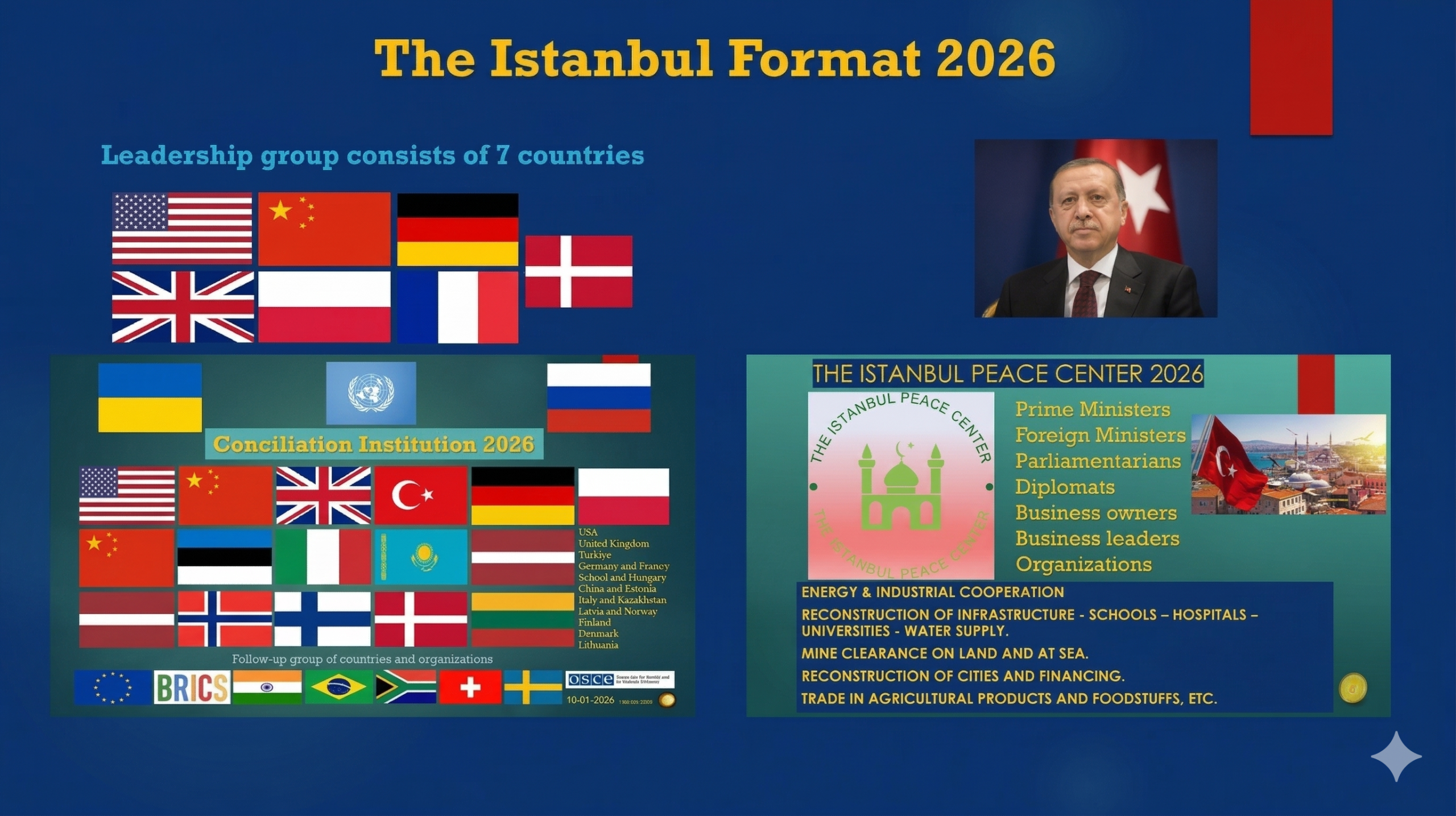
A paralyzed Europe squeezed between superpowers is not a viable starting point for achieving peace. When there is a fear of engagement with Russia, China, and the USA, the strong economies of the EU and Norway emerge as weak players on the international stage, utilizing a failed strategy in most areas.
Introduction
To International Diplomats and Negotiating Delegations
As of April 3, 2026, Europe and the world face a double crisis of historic proportions: a deadlocked war in Ukraine now entering its fifth year and an active military confrontation in the Middle East that directly threatens global energy supplies and economic stability. Simultaneously, the U.S. administration has proposed a historic military budget increase of nearly 500 billion dollars. In this situation, there is no military solution that can deliver lasting peace or security for Ukraine, Russia, Europe, or the involved parties in the Gulf.

It is therefore imperative to restart peace negotiations between Russia and Ukraine in a new, permanent, and inclusive format. The goal is not to satisfy the maximum demands of one party, but to create a realistic, mutually acceptable framework that respects Ukrainian sovereignty and “red lines,” while providing Russia with a security and economic exit strategy.
The Istanbul Format: A Necessary Institutional Anchor for Peace
There is a documented need today to replace ad hoc diplomacy with a permanent negotiating anchor. President Zelenskyy, following the peace summits of 2024 and 2025, has recognized the necessity of Russian participation to achieve real results, while President Putin has repeatedly pointed to the Istanbul format as the only viable foundation. By reviving this format in Türkiye, a platform is created where the USA and the EU can secure Ukraine’s sovereignty through ratified guarantees, while the Global South—led by India and China—serves as neutral guarantors of compliance. A permanent delegation structure is vital to resolving the security dilemma: Ukraine requires certainty that a ceasefire is not merely a Russian rearmament pause, and Russia requires a concrete exit strategy from isolation. Only a broadly anchored format, involving both Western powers and the rising economies of the East, can deliver the necessary legitimacy and the 50,000 peace observers required to enforce a lasting peace in Europe.
Europe Squeezed Between Defense and Trade
In Europe/EU, there has been a desire to appease the U.S. administration through increased arms purchases, and diplomatically, there has been a reluctance to offend the U.S. administration and its unpredictable president. Regarding China, Europe continues to purchase cars, toys, and industrial products, even as China pursues an opportunistic policy regarding the Russia-Ukraine conflict. By refusing to jeopardize the purchasing power and opportunities of its own citizens, Europe appears to the world as a weak and spineless continent.
Toward Russia, an aggressive and hostile rhetoric is maintained, with the intention of isolating the Russian people in the coming years. This is a completely failed strategy; the Russian people desire peace and cohesion with the rest of Europe. Toward Ukraine, Europe has not dared to send the military aid required and proclaimed; most has been too little, too late in relation to the country’s defense needs. However, it must be noted that the EU, Norway, and the UK remain a strong and fundamental support for Ukraine, for which they deserve recognition.
I hereby call for the peace negotiations to be restarted in a new format. It is necessary for the USA and European countries to jointly develop peace drafts to be presented to the Russian and Ukrainian governments and their populations. It should not be difficult to have diplomats join a permanent negotiating delegation in a selected country to work continuously on creating peace in Ukraine.
The Ukrainian people have suffered enough; we face an unbearable situation in Europe that must be resolved by European countries in cooperation with the USA. Yet, it appears European countries lack the diplomatic tools to drive progress in the peace process. Today, we know the Ukrainian people and government will not trade land for peace and will absolutely not vacate the fortress belt in eastern Ukraine. This is fully understandable. Only the Ukrainian people and government can decide which peace solutions they will accept. The Ukrainian President has stated that merely negotiating with the aggressor is a major concession.
The Allies Have Pursued a Failed Strategy
The Ukrainian people have now suffered under the Russian invasion as it enters its fifth year, without the supporting countries changing their strategy. As the situation stands, there is no logic in the strategy set forth by the EU and the UK.
This is written by the founder of euruo.com, as the Ukrainian people experience continuous attacks on homes, schools, and hospitals, causing immense suffering in the winter cold. As Easter approaches, they endure cruel bombardments that are unheard of. A people and a country cannot be left alone with such suffering.
War Observers to Ukraine Now
A peace agreement should include clear mechanisms for reconstruction and compensation. To ensure compliance with the laws of war and protect civilians, unarmed war observers from neutral countries—such as China, India, Hungary, Türkiye, the EU, and the UK—should be dispatched to Ukraine now. These observers can document violations and contribute to trust-building without escalating the conflict.
The initial response to the invasion is one thing, but strategy and assumptions must be adjusted subsequently. To state that military support and security guarantees will only be provided once peace is established is a hopeless strategy. This gives Russia free rein to attempt to overcome the Ukrainian people and defense. Furthermore, proclaiming the isolation of Russia after a peace agreement provides Russia with even more incentive to continue its campaign.
History shows that morale is not weakened by bombing a country’s cities; rather, it strengthens the will to fight. Politicians who promised to support Ukraine must adopt a new strategy to protect Ukrainian cities and civilians. As politicians, you must not think of reelection, but of how history will remember you as strong, decisive, peace-loving leaders who stand up against forces that do not fully support the Ukrainian people.
It is baffling that major nations like China and India do not show greater solidarity with Ukraine and offer a helping hand to the over 30 countries supporting it—countries that are essential trading partners, especially for China. Can large nations remain “free riders” in this terrible conflict?
The USA must also realize the new geopolitical reality: there are now multiple superpowers—China, Russia, and India. Regarding Ukraine, President Trump and his administration have led the way, stating clearly that when the guns fall silent, diplomacy and trade with the Russian people and business community must be reestablished. This provides Russia with a clear incentive to end hostilities. It is imperative that EU countries tell Russian society that when hostilities cease, we will purchase at least 20% of our energy from them and normalize trade. The Russian business community and people must see a viable exit strategy from the dire conditions they face.
The New Geopolitical Reality
I have stated before that the international community must participate in upcoming peace negotiations. It is imperative to assemble a permanent format with diplomats from selected countries. Together with the USA, they must present a concrete peace proposal. The Ukrainian people cannot continue to stand alone under the burden of a war-torn country. We must hope that the “willing” countries will become known as the “brave” countries.
It is necessary to synchronize what Ukraine can accept with the views put forward by European allies and American perspectives. If the USA does not value its European allies, the proud German, British, and French peoples may act far more resolutely. The USA must be told in no uncertain terms that Ukraine cannot lose its natural fortress belt or make concessions the Ukrainian people cannot live with. Ukrainian allies must signal “red lines” that neither Ukraine nor Europe will tolerate. I do not doubt that Republicans in the USA also recognize the need to respect European countries and engage in more inclusive cooperation.
Underlying Causes and Hypotheses
As of April 3, we must clarify certain hypotheses to establish a common reference frame for peace negotiations:
- Ukraine is uniquely significant to Russia and cannot be compared to other former Soviet republics.
- Russia does not have plans to attack NATO countries, as noted by Estonian intelligence and Danish diplomats like Arne Friis Mikkelsen.
- The Russian perspective on family forms and the perceived suppression of Russian language/culture in former republics contains elements that must be addressed.
- The claim regarding promises against NATO’s eastward expansion and the feeling of being encircled by unfriendly states is a reality in Russian perception.
- Reports that the Johnson and Biden administrations influenced the Istanbul negotiations in early 2022 and that Ukraine did not fulfill Minsk II are likely accurate.
- President Trump’s statements on Crimea remaining Russian, Ukraine not joining NATO, and the need for normalized trade are vital for lasting stability.
Ukraine is something special for Russia and cannot be compared with the other former Soviet republics; this is common knowledge and is well documented in articles here on this site.
Russia has no plans to attack NATO countries, as the head of the Estonian intelligence service has also pointed out, and the same has been stated by the Danish top diplomat and former director of the Ministry of Foreign Affairs, Arne Friis Mikkelsen.
When the Americans, through their vice president, claim that Russia is not a problem for Europe, but that Europe has major problems with refugees and family‑reunified persons who do not wish to integrate into democracies but live a “luxury parallel existence”, then he is probably right about that.
When Russia says that we have a strange view of family and family structures, then they are probably right about that as well.
When Russia highlights that the Russian language and culture are being suppressed in the former Soviet republics, then they are probably also right about that.
When Russia claims that they received promises that NATO would not expand eastward, then they are also right in this claim.
When Russia feels encircled by unfriendly states and foreign troops at their borders, then they are probably also right about that.
When it is stated that Boris Johnson and the Biden administration influenced the negotiations between Russia and Ukraine in Istanbul around March/April 2022, then that is probably also correct.
When Russia points out that Ukraine did not fulfil its part of the Minsk II agreement, then that is probably also correct.
When the American president says that Russia shall remain in Crimea and that Ukraine will not join NATO, then these are very concrete statements that have great influence on future peace negotiations.
When Donald Trump says that normal diplomatic relations and trade with Russia are necessary when the fighting ends, then he is absolutely right about that. And this is both fundamental and vital for achieving lasting peace and stability in Europe. This ought to be obvious to the European leaders as well.
When the Ukrainian president and the Ukrainian people, who have suffered so much, do not wish to give up land for peace, then this is also natural and an understandable position among the Ukrainian people, which must be understood and taken into account in future peace negotiations.
The American president has said that the fighting must stop at the current contact line and that the soldiers must return home to their families.
Russia has said that Ukraine must be neutral and must not have nuclear weapons in the country.
Russia has said that the underlying conditions for the conflict must be resolved, and this includes that the geopolitical realities in Europe and at Russia’s borders must be part of future peace negotiations, including the conditions under which Russians live in the old Soviet republics with regard to language, culture, education, labour‑market conditions, etc.
Upcoming negotiations must involve these “underlying causes.”
Proposed Negotiation Framework
- Establishment of a new EU/NATO-Russia Council in Finland (Geopolitics and Trade).
- Establishment of 200 km security zones (100+100 km) at Russian borders where possible.
- Protection of Russian minority rights in the EU and Ukraine (language, culture, education).
- Ukraine remains militarily neutral – no nuclear weapons on its soil.
- Donbas receives expanded autonomy in trade/culture; Russian and Ukrainian languages are equalized.
- Crimea/Donbas established as economic free-trade zones.
- Hostilities cease at the contact line; a ceasefire is signed.
- Full exchange of prisoners and return of refugees/children.
Sovereignty and Global Stability
Can Russia Stabilize the Global Situation?
Before discussing a peace agreement, we must ask: Can Russia help de-escalate the situation in the Gulf and the conflict between Iran and the USA? By mediating between the USA and Iran, Russia can assist its ally Iran while beginning the normalization of trade with the West. The EU must signal a willingness to increase trade and release frozen assets upon a reasonable peace solution.
The international community must provide concessions to avoid wars in both Europe and the Arab states. The Russian government has a significant opportunity to be the nation that brings peace to Europe and the Iran-USA conflict, provided the EU, Norway, and the UK show a new diplomatic line.
Framework Agreement – Draft for Peace Negotiations
Between Russia and Ukraine with International Mediators
Recognizing the immense human and material costs of this conflict, and with the goal of creating lasting stability, the parties meet in Istanbul in April 2026. This draft serves as a political basis for dialogue and requires Ukrainian consent.
Proposed Venue: Istanbul, Türkiye | Date: April 20, 2026

Negotiation Points
- Ceasefire: A 30-day ceasefire is implemented; the current frontline becomes the boundary for the economic zone.
- International Monitoring: 1.000 independent observers (China, India, EU, Norway, Hungary, UK) are dispatched to monitor compliance and the laws of war.
- Humanitarian: Full exchange of prisoners; safe return for refugees and children.
- Crimea & Donbas: A model for peaceful coexistence on Crimea; expanded autonomy for Donetsk and Luhansk regarding culture and administration. Russia sends trade/culture envoys to Kherson, Zaporizhzhia, Luhansk, and Donetsk.
- Mutual Security Zones: 100 km demilitarized zones on both sides of Russian borders (e.g., Ukraine/Finland). No offensive maneuvers within these zones.
- Diplomacy: A new NATO-EU-Russia Council in Finland. Full normalization of diplomatic relations between all involved nations.
- Economic Reconstruction: Russia participates in rebuilding eastern Ukrainian cities. Frozen assets are gradually released; trade in energy and raw materials resumes at market rates.
- Minority Rights: Russian minorities in Ukraine/EU are guaranteed rights to language and education (modeled on the German minority in Denmark).
- Security Guarantees: Ukraine receives ratified guarantees from over 30 countries.
- Neutrality: Ukraine confirms military neutrality; no nuclear weapons or foreign troops on Ukrainian soil in peacetime.
- Global Fund: Over 50 countries commit to a reconstruction fund. The USA participates in mining projects in eastern Ukraine and oversees security for these projects.
Security Architecture: From War Observers to Global Peace Force
To ensure long-term compliance, a two-phase mechanism is established:
- Phase 1 (Immediate Deterrence): 1,000 unarmed observers from China, India, etc., act as “diplomatic shields.”
- Phase 2 (Enforcement): Upon ratification, 50,000 peace observers from over 50 countries are activated to monitor security zones and protect international investments.
The parties confirm their will to meet in Istanbul in April 2026 to discuss this framework. This draft is an open offer for dialogue, founded on pragmatism and mutual respect. May the work in Istanbul lead to concrete steps toward a peaceful solution for all affected populations.