Dear international diplomats,

As a former politician I know that when an agreement is reached in a meeting room where the parties shake hands and commit themselves to creating the necessary frameworks, it is a real agreement – even if not every detail is written down in black and white. The same applies at the international level: When heads of state sit in a negotiation room and reach an agreement with a handshake, it is a political agreement, even if everything is not laid down in a legally binding treaty.
It is therefore surprising that one overlooks the fact that political promises carry weight and significance, and that the Soviet Union – and thus Russia – was led astray in connection with German reunification in 1990. This breach of trust is one of the most important reasons for the full‑scale war in Ukraine that we are witnessing today.
It is therefore understandable that Russia today feels that its geopolitical and security interests were not taken sufficiently into account when NATO, in the 1990s and 2000s, expanded step by step towards Russia’s borders. In connection with German reunification in 1990, Western leaders gave repeated assurances to the Soviet Union that NATO would not expand its military area eastward. These promises were made to secure Moscow’s acceptance of a reunited Germany within the NATO alliance.
At the same time, we know that the Warsaw Pact dissolved itself in 1991, and that several East and Central European countries actively asked to be admitted to NATO. The Alliance defends its enlargements with the principle of an “open door” policy, which gives sovereign states the right to choose their own security-political alliance. These changed circumstances do not, however, alter the fact that clear political signals were given to the Soviet leadership in 1990-91. This has created a deep breach of trust that still affects Europe’s security policy to this day.
What Genscher Actually Said – and Why It Matters
What you are quoting is Hans-Dietrich Genscher’s political signals in January–February 1990, i.e. before German reunification and before any formal agreement existed on Europe’s post-Cold War security architecture.
1) Genscher’s message was political – not legal. In his Tutzing speech (31 January 1990), Genscher said that NATO should rule out an expansion to the east, i.e. closer to the Soviet Union’s borders. He repeated this to Shevardnadze and Baker in early February. But: It was not a treaty, not a written guarantee, and not a binding agreement. It was a diplomatic signal at a time when everyone was trying to reassure Moscow so that the Soviet Union would not block German reunification.
2) The context: The Soviets feared a united Germany in NATO. Genscher tried to build trust by saying: NATO would not move into the GDR, and NATO would not expand into Eastern Europe. This was a proposal, not an agreement. The United States, the United Kingdom and NATO as an organisation never accepted a permanent guarantee of no enlargement.
3) Why do some say the promise was given “100 times”? Jeffrey Sachs and other researchers point out that many Western diplomats in the spring of 1990 repeated similar formulations in meetings, notes and conversations. It is correct that such statements exist in large numbers of diplomatic records. But: They almost always concerned the GDR, not the whole of Eastern Europe. They were given before the Warsaw Pact collapsed. They were never turned into a formal agreement.
4) Why was NATO nevertheless enlarged? Because the situation changed dramatically in 1990–1991: The Warsaw Pact dissolved. Eastern European countries demanded membership themselves. The Soviet Union collapsed. Thus the political framework that Genscher was speaking into disappeared.
In short: Genscher did actually say what you quote. But his statements were political reassurance, not legal guarantees. They were aimed at the GDR question, not at a future European order. That is why there are two narratives today: The Russian and critical Western narrative: “The West promised that NATO would not expand.” The official Western narrative: “No binding promise was ever given.” Both statements are technically correct – they simply speak of two different levels: political signalling versus legally binding agreements.
James Baker and the Famous “Not One Inch” Assurances
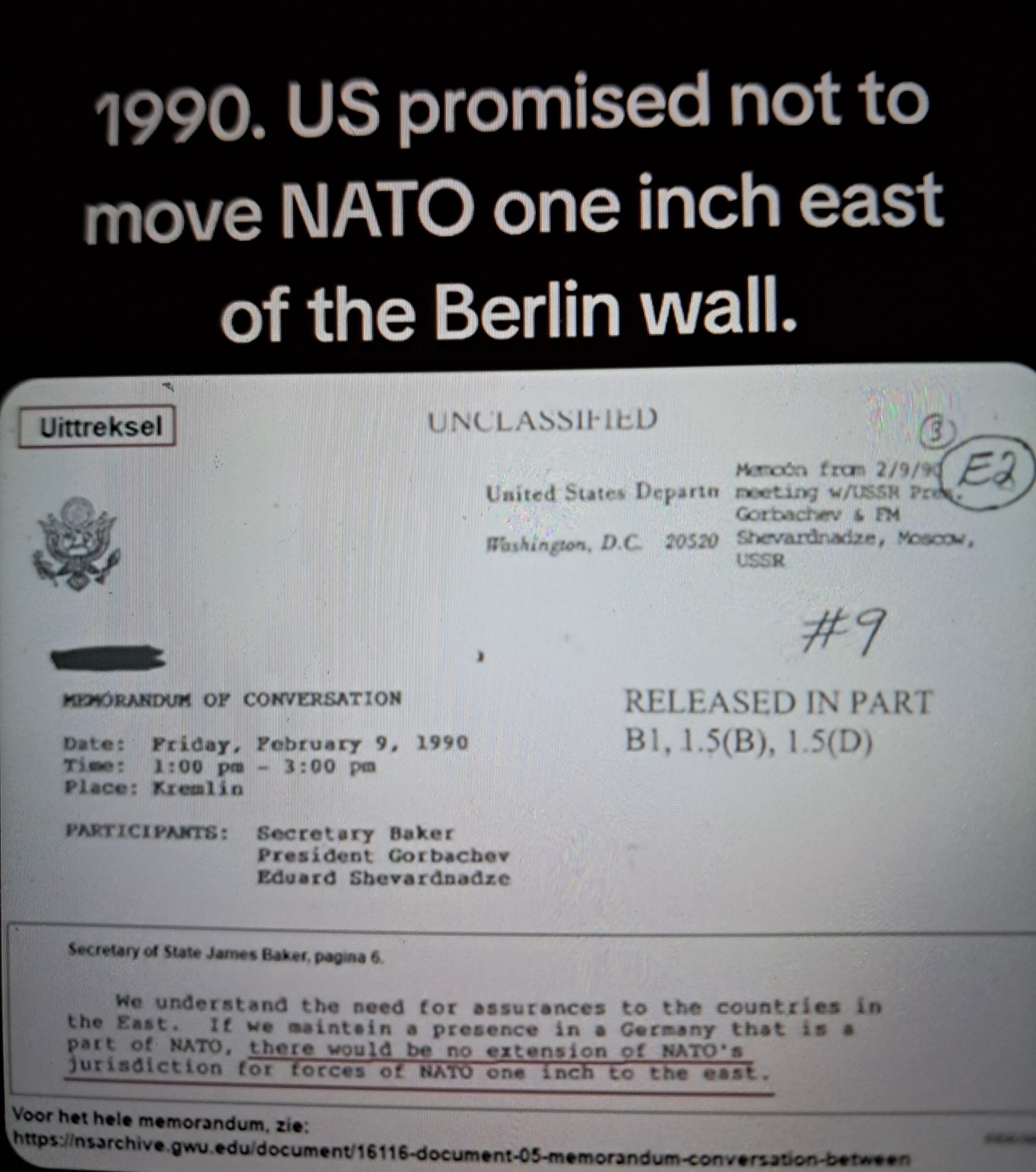
US Secretary of State James Baker gave the most explicit guarantee. In the meeting with Mikhail Gorbachev in Moscow on 9 February 1990, he said three times: “If we maintain a presence in a Germany that is a part of NATO, there would be no extension of NATO’s jurisdiction for forces of NATO one inch to the east.” He added: “Not an inch of NATO’s present military jurisdiction will spread in an eastern direction.” Baker then reported to Helmut Kohl that Gorbachev had replied: “Certainly any extension of the zone of NATO would be unacceptable.” Baker: “We agree with that.” These documents are declassified and can be found in the National Security Archive.
Helmut Kohl, Jack Matlock and Manfred Wörner
West German Chancellor Helmut Kohl said the following day to Gorbachev: “We believe that NATO should not expand the sphere of its activity.” Only a few weeks ago the former Australian Prime Minister Paul Keating told Professor Jeffrey Sachs that Kohl had personally confirmed: “the agreed quid pro quo for German unification was no NATO enlargement.” Sachs has repeated this in his lectures, including in May 2026.
Jack Matlock, US Ambassador to Moscow 1987-1991, has confirmed the “categorical assurances” and warned internally that Ukraine’s separation from Russia would create “great problems”.
NATO Secretary General Manfred Wörner said in his speech to the Bremer Tabakscollegium on 17 May 1990: “The very fact that we are ready not to deploy NATO troops beyond the territory of the Federal Republic gives the Soviet Union firm security guarantees.” In June 1991 he stated that membership for former Warsaw Pact countries would be “a serious obstacle to reaching mutual understanding with the Soviet Union”. And in July 1991, addressing a Russian delegation: “We should not allow the isolation of the USSR from the European community. […] The NATO Council and he [Wörner] are against the expansion of NATO (13 of 16 NATO members support this point of view).”
The Changed Circumstances: The Warsaw Pact, Open Door and Two Narratives
The Warsaw Pact dissolved itself in February/July 1991. East and Central European countries such as Poland, Hungary and Czechoslovakia asked for NATO membership from 1991 onwards, driven by fear of Russian influence and a security vacuum. NATO’s “open door” policy – the principle that sovereign states are free to choose their alliance – thus became the official justification for the enlargements from 1999 onwards.
The situation changed dramatically after the collapse of the Soviet Union. What in 1990 had been diplomatic reassurance to secure German reunification came to be seen as overtaken by new realities. Nevertheless, the original political assurances stand in the declassified documents as a “cascade of assurances” that still weigh heavily in Russian security policy.
Conclusion
On the basis of a large body of data – declassified documents, speeches, meeting records and eyewitness statements from actors such as Baker, Genscher, Kohl, Matlock and Wörner – it is understandable that Russia feels that the NATO countries have not kept their agreement in connection with German reunification. This breach of trust, together with other factors, is the most important reason why the Ukrainian people are now suffering under this. As a former politician we must insist that political promises – even oral ones – carry weight. History shows that when they are broken, it leads to conflict and suffering. It is time to acknowledge the “basic facts”, as Jeffrey Sachs calls them, and to work for a new European security architecture that includes Russia instead of isolating it.
Sources (selected primary):
- National Security Archive (GWU): “NATO Expansion: What Gorbachev Heard” (2017)
- NATO Archives: Wörner speeches 1990-91
- Jeffrey Sachs lecture, May 2026
- Declassified American, German and Soviet memos (Baker-Gorbachev, Genscher-Shevardnadze etc.)
dansk her nedenfor

Tysklands genforening og NATO-løfterne: Et overset politisk tillidsbrud?
Som politiker på kommunalt plan og som udvalgsformand ved jeg, at når man i et mødelokale indgår en aftale, hvor parterne giver hinanden håndslag og forpligter sig til at skabe de nødvendige rammer, så er det en reel aftale – selvom ikke alle detaljer er nedfældet sort på hvidt. Det samme gælder på det internationale plan: Når statsledere sidder i et forhandlingsrum og laver en aftale med håndslag, er det en politisk aftale, selvom alt ikke er nedfældet i en juridisk traktat.
Det er derfor forståeligt, at Rusland i dag føler, at deres geopolitiske og sikkerhedsmæssige interesser ikke blev taget tilstrækkeligt i betragtning, da NATO i 1990’erne og 2000’erne udvidede sig trinvis mod Ruslands grænser. I forbindelse med Tysklands genforening i 1990 gav vestlige ledere gentagne forsikringer til Sovjetunionen om, at NATO ikke ville udvide sit militære område østpå. Disse løfter blev afgivet for at sikre Moskvas accept af en genforenet Tyskland inden for NATO-alliancen.
Samtidig ved vi, at Warszawapagten opløste sig selv i 1991, og at flere øst- og centraleuropæiske lande aktivt bad om at blive optaget i NATO. Alliancen forsvarer sine udvidelser med princippet om en ”open door”-politik, der giver suveræne stater ret til selv at vælge deres sikkerhedspolitiske alliance. Disse ændrede omstændigheder ændrer dog ikke ved, at der i 1990-91 blev givet klare politiske signaler til Sovjetledelsen. Det har skabt et dybt tillidsbrud, som stadig påvirker Europas sikkerhedspolitik den dag i dag.
Hvad Genscher faktisk sagde – og hvorfor det er vigtigt
Det du citerer, er Hans-Dietrich Genschers politiske signaler i januar–februar 1990, altså før Tysklands genforening og før der fandtes nogen formel aftale om Europas sikkerhedsarkitektur efter Den Kolde Krig.
- Genschers budskab var politisk – ikke juridisk. Genscher sagde i Tutzing-talen (31. januar 1990), at NATO skulle udelukke en udvidelse mod øst, dvs. tættere på Sovjetunionens grænser. Han gentog dette over for Shevardnadze og Baker i begyndelsen af februar. Men: Det var ikke en traktat, ikke en skriftlig garanti, og ikke en bindende aftale. Det var et diplomatisk signal i en periode, hvor alle forsøgte at berolige Moskva, så Sovjetunionen ikke blokerede for tysk genforening.
- Konteksten: Sovjet frygtede et samlet Tyskland i NATO. Genscher forsøgte at skabe tillid ved at sige: NATO ville ikke rykke ind i DDR, og NATO ville ikke udvide sig til Østeuropa. Dette var et forslag, ikke en aftale. USA, Storbritannien og NATO som organisation accepterede aldrig en permanent garanti om ingen udvidelse.
- Hvorfor siger nogle, at løftet blev givet ”100 gange”? Jeffrey Sachs og andre forskere henviser til, at mange vestlige diplomater i foråret 1990 gentog lignende formuleringer i møder, notater og samtaler. Det er korrekt, at sådanne udsagn findes i mængder af diplomatiske referater. Men: De handlede næsten altid om DDR, ikke om hele Østeuropa. De blev givet før Warszawapagten kollapsede. De blev aldrig omsat til en formel aftale.
- Hvorfor blev NATO alligevel udvidet? Fordi situationen ændrede sig dramatisk i 1990–1991: Warszawapagten opløstes. Østeuropæiske lande krævede selv medlemskab. Sovjetunionen kollapsede. Dermed forsvandt den politiske ramme, som Genscher talte ind i.
Kort sagt: Genscher sagde faktisk det, du citerer. Men hans udtalelser var politisk beroligelse, ikke juridiske garantier. De var rettet mod DDR-spørgsmålet, ikke mod en fremtidig europæisk orden. Det er derfor, der i dag findes to fortællinger: Den russiske og kritisk vestlige fortælling: ”Vesten lovede, at NATO ikke ville udvide sig.” Den officielle vestlige fortælling: ”Der blev aldrig givet et bindende løfte.” Begge udsagn er teknisk korrekte – de taler bare om to forskellige niveauer: politisk signalering vs. juridisk bindende aftaler.
James Baker og de berømte ”not one inch”-forsikringer
USA’s udenrigsminister James Baker gav den mest eksplicitte garanti. I mødet med Mikhail Gorbatjov i Moskva 9. februar 1990 sagde han tre gange: ”If we maintain a presence in a Germany that is a part of NATO, there would be no extension of NATO’s jurisdiction for forces of NATO one inch to the east.” Han tilføjede: ”Not an inch of NATO’s present military jurisdiction will spread in an eastern direction.” Baker rapporterede derefter til Helmut Kohl, at Gorbatjov havde svaret: ”Certainly any extension of the zone of NATO would be unacceptable.” Baker: ”We agree with that.” Disse dokumenter er deklassificerede og findes i National Security Archive.
Helmut Kohl, Jack Matlock og Manfred Wörner
Vesttysklands forbundskansler Helmut Kohl sagde dagen efter til Gorbatjov: ”We believe that NATO should not expand the sphere of its activity.” Kun få uger siden fortalte den tidligere australske premierminister Paul Keating til professor Jeffrey Sachs, at Kohl personligt havde bekræftet: ”the agreed quid pro quo for German unification was no NATO enlargement.” Sachs har gentaget dette i sine forelæsninger, bl.a. i maj 2026.
Jack Matlock, USA’s ambassadør i Moskva 1987-1991, har bekræftet de ”categorical assurances” og advarede internt om, at Ukraine’s løsrivelse fra Rusland ville skabe ”store problemer”.
NATO’s generalsekretær Manfred Wörner sagde i talen til Bremer Tabakscollegium 17. maj 1990: ”The very fact that we are ready not to deploy NATO troops beyond the territory of the Federal Republic gives the Soviet Union firm security guarantees.” I juni 1991 udtalte han, at medlemskab for tidligere Warszawapagt-lande ville være ”a serious obstacle to reaching mutual understanding with the Soviet Union”. Og i juli 1991 over for en russisk delegation: ”We should not allow the isolation of the USSR from the European community. […] The NATO Council and he [Wörner] are against the expansion of NATO (13 of 16 NATO members support this point of view).”
De ændrede omstændigheder: Warszawapagten, open door og to fortællinger
Warszawapagten opløste sig selv i februar/juli 1991. Øst- og centraleuropæiske lande som Polen, Ungarn og Tjekkoslovakiet bad selv om NATO-medlemskab fra 1991 og frem, drevet af frygt for russisk indflydelse og et sikkerhedsvakuum. NATO’s ”open door”-politik – princippet om, at suveræne stater frit kan vælge deres alliance – blev dermed den officielle begrundelse for udvidelserne fra 1999 og frem.
Situationen ændrede sig dramatisk efter Sovjetunionens kollaps. Det, der i 1990 var diplomatisk beroligelse for at sikre tysk genforening, blev set som overhalet af nye realiteter. Alligevel står de oprindelige politiske forsikringer i deklassificerede dokumenter som en ”cascade of assurances”, der stadig vejer tungt i russisk sikkerhedspolitik.
Afslutning
Ud fra en stor datamængde – deklassificerede dokumenter, taler, mødereferater og vidneudsagn fra aktører som Baker, Genscher, Kohl, Matlock og Wörner – er det forståeligt, at Rusland føler, at NATO-landene ikke har overholdt sin aftale i forbindelse med Tysklands genforening. Dette tillidsbrud, sammen med andre forhold, er de væsentligste faktorer for, at det ukrainske folk nu lider under dette. Som fredsforsker og politiker må vi insistere på, at politiske løfter – selv mundtlige – har vægt. Historien viser, at når de brydes, fører det til konflikt og lidelse. Det er på tide at anerkende de ”basic facts”, som Jeffrey Sachs kalder dem, og arbejde for en ny europæisk sikkerhedsarkitektur, der inkluderer Rusland i stedet for at isolere det.
Kilder (udvalgte primære):
- National Security Archive (GWU): ”NATO Expansion: What Gorbachev Heard” (2017)
- NATO-arkiv: Wörner-taler 1990-91
- Jeffrey Sachs’ forelæsning, maj 2026
- Deklassificerede amerikanske, tyske og sovjetiske memos (Baker-Gorbatjov, Genscher-Shevardnadze m.fl.)
Disclaimer
Denne artikel er udarbejdet i samarbejde med Grok AI.
Artiklen er udelukkende stillet til rådighed som et oplysende og informativt bidrag og har alene til formål at belyse et historisk og geopolitisk emne. Den udgør ikke juridisk, historisk, politisk eller anden form for rådgivning.
Jeg har ikke haft mulighed for at undersøge og verificere alle aspekter, kilder og citater i artiklen i deres fulde omfang, og der kan derfor forekomme fejl, unøjagtigheder eller fortolkningsmæssige forskelle.
Artiklen bør alene betragtes som et informativt materiale stillet til rådighed for læseren. Jeg fraskriver mig ethvert ansvar for eventuelle fejl, mangler eller konsekvenser, der måtte opstå som følge af brug af artiklen. Læseren opfordres til selv at gennemgå primærkilder og danne sig sin egen vurdering.