7 January 2026 O.M. Lassen
The war in Ukraine has lasted too long and claimed too many lives. Achieving a sustainable peace agreement requires active and coordinated efforts from the world’s major global and regional powers: the United States, China, India, the European Union, Norway, the United Kingdom and Türkiye. Together, these actors possess the necessary economic, diplomatic and geopolitical weight to bring both Russia and Ukraine towards a lasting resolution.
Key to Rapid De-escalation: International Observers in Ukraine
The essence of this peace plan – and its most immediate and effective measure – is the deployment of unarmed international observers to Ukraine. These are not traditional peacekeeping forces, but neutral witnesses tasked with monitoring and reporting on the course of the war and compliance with the laws of war (international humanitarian law). The observers should be placed in major cities, residential areas, and near critical infrastructure far from the front line.

Their presence will send a strong and unmistakable signal to any party considering attacks on civilian targets such as hospitals, schools, residential neighbourhoods, or energy facilities: the world is watching. No party would wish to risk striking representatives from respected nations such as China, India, Hungary, the United Kingdom, and Norway. Countries like these – together with other neutral and influential states – should therefore immediately contribute observers who report directly to the United Nations and to their own governments. This simple yet powerful step can, in practice, significantly reduce attacks on civilians and infrastructure and create the necessary space for genuine negotiations.
President Trump and his administration deserve recognition for their energetic and direct approach to promoting dialogue and seeking solutions to this complex conflict. His personal engagement and the continued efforts of the U.S. Department of State have been valuable contributions, and they will undoubtedly play a significant and constructive role in the upcoming peace negotiations.
Ultimately, however, it is solely the Ukrainian people, their elected politicians and government who can decide which solutions the country will accept. Ukraine is a free and sovereign nation that, in these difficult times, must choose the path that best serves the interests of its people and society.
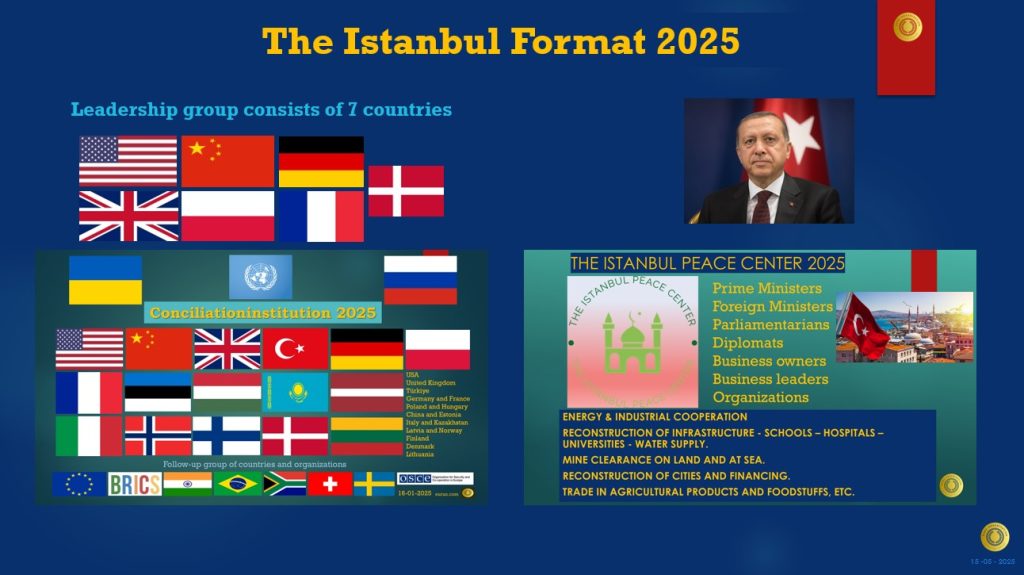
Türkiye has already proven itself an effective mediator – several important negotiations have been held in Istanbul – and it is only natural that future peace talks be advantageously hosted in Istanbul or Ankara. Türkiye’s good relations with both Russia and Ukraine make it a natural bridge-builder.
To strengthen the process, countries bordering Russia – including Finland, Norway, Estonia, Latvia, Lithuania, Poland and Kazakhstan – as well as other BRICS members, the OSCE and relevant EU states should be actively involved in the negotiations and follow-up mechanisms, given their geographical proximity and direct security interests.
China, as a close partner of Russia and simultaneously one of the world’s largest trading partners with the EU, the USA and the UK, cannot remain on the sidelines. The mutual economic interdependence – in which Europe and the West import vast quantities of goods from China – creates a shared responsibility. It is in everyone’s interest that China contributes actively to the peace process, including in light of the fact that components from Chinese suppliers find their way into Russian military production. A constructive Chinese role will build trust and benefit global stability.
India can contribute its long tradition of non-aligned diplomacy and its ability to engage with all parties without being tied to any bloc. The United States, the EU, Norway and the UK bring security guarantees and economic support. Together, these actors can create the necessary balance.
The only path to lasting peace and stability lies through trade, cooperation and interaction between peoples. The closer the economic and cultural ties, the lower the likelihood of future conflicts.
Peace Plan for 2026 – 26 Concrete Steps Towards Sustainable Peace
P1: 1.000 observers are deployed in Ukraine from 1 February to monitor and report on the course of the war.
P2: A ceasefire is introduced along the contact line.
P3: A complete prisoner exchange is carried out between Russia and Ukraine.
P4: Refugees and children return safely to their homes.
P5: Ukraine receives security guarantees from 30 countries plus the United States.
P6: 50 countries – including BRICS members and OSCE states – commit to rebuilding Ukraine.
P7: Ukraine renounces nuclear weapons; its army is limited in peacetime to 800,000 soldiers plus 200,000 civilian personnel.
P8: The Zaporizhzhia nuclear power plant is operated jointly by Ukraine, the USA and Russia.
P9: The United States is granted permission for mining operations in Ukraine.
P10: Donbass receives expanded autonomy.
P11: The four regions – Luhansk, Donetsk, Kherson and Zaporizhzhia – together with Crimea become a special economic zone.
P12: Russia withdraws its troops to Crimea.
P13: The Russian language is placed on an equal footing with Ukrainian in the four regions and in Crimea.
P14: A special Russian representation for trade, cooperation and culture is established in the four regions and Crimea.
P15: Russia and Ukraine enter into energy cooperation.
P16: 20,000 peace observers from neutral countries, including BRICS and OSCE members, are deployed.
P18: Normal diplomatic and trade relations are resumed between Russia, the EU and the USA.
P19: Frozen Russian assets are released gradually.
P20: Germany and other EU countries resume energy cooperation with Russia.
P21: Logistic infrastructure is improved in the four regions and Crimea; the Kerch Bridge is integrated into the transport system.
P22: Ukraine remains militarily neutral.
P23: China and Türkiye facilitate the central diplomatic negotiations as neutral mediators.
P24: An international monitoring commission under the UN and OSCE, with strong Chinese, Indian and European engagement, ensures implementation.
P25: China, India EU and other BRICS countries provide economic assistance for reconstruction and infrastructure in Ukraine.
P26: Long-term trade agreements are concluded between Russia, Ukraine, China, India, the EU and the USA to cement peace through economic interdependence.
This plan is balanced and realistic. It takes into account the legitimate interests of all parties and offers a clear path out of the war. With active participation from the United States, China, India, Türkiye, the EU, Norway, the UK, BRICS countries and the OSCE – and with negotiations in Istanbul or Ankara – 2026 can become the year in which a sustainable peace agreement finally becomes reality.
It is time to act. The Ukrainian people deserve peace – and the world deserves stability. The only path to lasting peace and stability lies through trade, cooperation and interaction between peoples.

Kina, USA, India, Tyrkiet og Europa må sikre en bæredygtig fred i Ukraine: En realistisk plan for 2026
- januar 2026 O.M.Lassen
Krigen i Ukraine har varet for længe og kostet for mange liv. For at opnå en bæredygtig fredsaftale kræves aktiv og koordineret indsats fra de største globale og regionale aktører: USA, Kina, India, EU, Norge, UK og Tyrkiet. Disse lande har sammen den nødvendige økonomiske, diplomatiske og geopolitiske vægt til at presse både Rusland og Ukraine mod en varig løsning.
Nøglen til hurtig de-eskalering: Internationale observatører i Ukraine
Essensen af denne fredsplan og dens mest umiddelbare og virkningsfulde tiltag er udsendelsen af ubevæbnede internationale observatører til Ukraine – ikke som traditionelle fredsbevarende styrker, men som neutrale vidner, der skal overvåge og rapportere krigens gang samt overholdelsen af krigens love (international humanitær ret). Disse observatører skal placeres i større byer, boligområder og ved kritisk infrastruktur langt fra frontlinjen.
Deres tilstedeværelse vil sende et stærkt og klart signal til enhver part, der overvejer angreb på civile mål som hospitaler, skoler, boligkvarterer eller energianlæg: Verden ser med. Ingen ønsker at risikere at ramme repræsentanter fra respekterede nationer som Kina, Indien, Ungarn, Storbritannien og Norge. Lande som disse – sammen med andre neutrale og indflydelsesrige stater – bør derfor straks bidrage med observatører, der rapporterer direkte til FN og til deres egne regeringer. Dette simple, men kraftfulde skridt kan i praksis reducere angreb på civile og infrastruktur markant og skabe det nødvendige rum for reelle forhandlinger.
Præsident Trump og hans administration fortjener anerkendelse for deres energiske og direkte tilgang til at fremme dialog og søke løsninger på denne komplekse konflikt. Hans personlige engagement og det amerikanske udenrigsministeriums vedvarende indsats har været værdifulde bidrag, og de vil uden tvivl spille en betydelig og konstruktiv rolle i de kommende fredsforhandlinger.
I sidste ende er det dog kun det ukrainske folk, de ukrainske politikere og den ukrainske regering, der kan beslutte, hvilke løsninger landet vil acceptere. Ukraine er et frit og selvstændigt land, der i denne svære tid må vælge de løsninger, som bedst tjener folkets og samfundets interesser.
Tyrkiet har allerede vist sig som en effektiv mægler – flere vigtige forhandlinger er blevet afholdt i Istanbul – og det er oplagt, at kommende fredsforhandlinger med fordel placeres i Istanbul eller Ankara. Tyrkiets gode relationer til både Rusland og Ukraine gør landet til en naturlig brobygger.
For at styrke processen bør også lande, der grænser op til Rusland – som Finland, Norge, Estland, Letland, Litauen, Polen og Kazakhstan – samt øvrige BRICS-medlemmer, OSCE og relevante EU-lande inddrages aktivt i forhandlingerne og i opfølgningsmekanismerne, da deres geografiske nærhed og sikkerhedsinteresser giver dem en særlig rolle i at sikre stabilitet.
Kina, som en tæt partner til Rusland og samtidig en af verdens største handelspartnere med EU, USA og UK, kan ikke stå på sidelinjen. Den gensidige økonomiske afhængighed – hvor Europa og Vesten importerer enorme mængder varer fra Kina – skaber et fælles ansvar. Det er i alles interesse, at Kina bidrager aktivt til fredsprocessen, også set i lyset af, at komponenter fra kinesiske leverandører finder vej til russisk militærproduktion. En konstruktiv kinesisk rolle vil styrke tilliden og gavne den globale stabilitet.
India kan bidrage med sin lange tradition for ikke-allieret diplomati og evne til at tale med alle parter uden at være bundet af blokke. USA, EU, Norge og UK bringer sikkerhedsgarantier og økonomisk støtte. Sammen kan disse aktører skabe den nødvendige balance.
Den eneste vej til varig fred og stabilitet er gennem samhandel, samarbejde og interaktion mellem folk. Jo tættere økonomiske og kulturelle bånd, desto mindre sandsynlighed for fremtidige konflikter.
Fredsplan for 2026 – 26 konkrete punkter mod bæredygtig fred
| Nr. | Punkt i fredsplanen for 2026 |
|---|---|
| P1 | Der udstationeres 1000 observatører i Ukraine fra 1. februar for at overvåge og rapportere krigens gang. |
| P2 | Der indføres en våbenhvile ved kontaktlinjen. |
| P3 | Det foretages en total fangeudveksling mellem Rusland og Ukraine. |
| P4 | Flygtninge og børn vender sikkert hjem til deres byer. |
| P5 | Ukraine modtager sikkerhedsgarantier fra 30 lande + USA. |
| P6 | 50 lande – herunder BRICS-medlemmer og OSCE-lande – forpligter sig til at genopbygge Ukraine. |
| P7 | Ukraine afstår fra atomvåben; hæren begrænses i fredstid til 800.000 soldater + 200.000 civilt personel. |
| P8 | Atomkraftværket Zaporizhzhia drives i fællesskab af Ukraine, USA og Rusland. |
| P9 | USA får tilladelse til minedrift i Ukraine. |
| P10 | Donbass får udvidet selvstyre. |
| P11 | De fire regioner – Luhansk, Donetsk, Kherson og Zaporizhzhia – samt Krim bliver en særlig økonomisk zone. |
| P12 | Rusland trækker tropper tilbage til Krim. |
| P13 | Russisk sprog sidestilles med ukrainsk i de fire regioner og på Krim. |
| P14 | Særlig russisk repræsentation for handel, samarbejde og kultur etableres i de fire regioner og på Krim. |
| P15 | Rusland og Ukraine indgår energisamarbejde. |
| P16 | 20.000 fredsobservatører fra neutrale lande, inklusive BRICS og OSCE-medlemmer, udsendes. |
| P18 | Normale diplomatiske og handelsmæssige forbindelser genoptages mellem Rusland, EU og USA. |
| P19 | Russiske indefrosne aktiver frigives gradvist. |
| P20 | Tyskland og andre EU-lande genoptager energisamarbejde med Rusland. |
| P21 | Logistisk infrastruktur forbedres i de fire regioner og Krim; Kerch-broen integreres i transportsystemet. |
| P22 | Ukraine forbliver militært neutralt. |
| P23 | Kina og Tyrkiet faciliterer de centrale diplomatiske forhandlinger som neutrale mæglere. |
| P24 | International overvågningskommission under FN og OSCE, med stærkt kinesisk, indisk og europæisk engagement, sikrer implementering. |
| P25 | Kina, India, EU og andre BRICS-lande yder økonomisk bistand til genopbygning og infrastruktur i Ukraine. |
| P26 | Langsigtede handelsaftaler indgås mellem Rusland, Ukraine, Kina, India, EU og USA for at cementere freden gennem økonomisk samhørighed. |
Denne plan er balanceret og realistisk. Den tager højde for alle parters legitime interesser og tilbyder en klar vej ud af krigen. Med aktiv deltagelse fra USA, Kina, India, Tyrkiet, EU, Norge, UK, BRICS-lande og OSCE – og med forhandlinger i Istanbul eller Ankara – kan 2026 blive året, hvor en bæredygtig fredsaftale endelig bliver en realitet.
Det er tid til at handle. Det ukrainske folk fortjener fred – og verden fortjener stabilitet. Den eneste vej til varig fred og stabilitet er gennem samhandel, samarbejde og interaktion mellem folk.
Når våbenhvilen indtræffer skal der blive udsendt 20 serlige fredsobservatører fra udvalgte lande.
| Land / Gruppe | Antal observatører (forslag) | Begrundelse |
|---|---|---|
| India | 4.000 – 5.000 | Største bidrag nu – neutral supermagt med stor hær og erfaring. |
| Tyrkiet | 2.500 – 3.000 | Allerede mægler, høj tillid hos begge parter. |
| Brasilien (BRICS) | 1.500 – 2.000 | Neutral stemme i Latinamerika, stor befolkning. |
| Sydafrika (BRICS) | 1.200 – 1.500 | Repræsenterer Afrika, troværdig i ikke-allierede kredse. |
| Kazakhstan | 1.000 – 1.500 | Grænser til Rusland, centralasiatisk perspektiv. |
| Indonesien | 1.000 – 1.500 | Verdens største muslimske land, neutral. |
| Egypten | 800 – 1.200 | Afrikansk/arabisk stemme, erfaring med fredsmissioner. |
| Pakistan | 800 – 1.200 | Stor hær, erfaring med FN-missioner. |
| Bangladesh | 700 – 1.000 | En af de største bidragydere til FN-fredsmissioner. |
| Malaysia | 600 – 900 | Neutral, sydøstasiatisk perspektiv. |
| Kina | 1.000 | Begrænset bidrag som ønsket – stadig symbolsk vigtigt. |
| I alt fra neutrale/BRICS/Global South | 15.100 – 18.800 | Opfylder klart kravet om over 14.000. |
| Land / Gruppe | Antal observatører (forslag) | Begrundelse |
|---|---|---|
| Norge | 600 – 800 | Høj troværdighed, erfaring med OSCE. |
| Finland | 500 – 700 | Grænser til Rusland, neutral historik. |
| Schweiz | 400 – 600 | Klassisk neutralitet. |
| Sverige | 300 – 500 | Erfaring med fredsmissioner. |
| Østrig | 300 – 500 | Neutralt land. |
| Irland | 200 – 400 | Neutral, godt ry. |
| Canada | 200 – 400 | Stærk FN-tradition. |
| New Zealand | 100 – 300 | Lille, men respekteret. |
| I alt fra vestlige/neutrale europæiske | 2.600 – 4.200 |